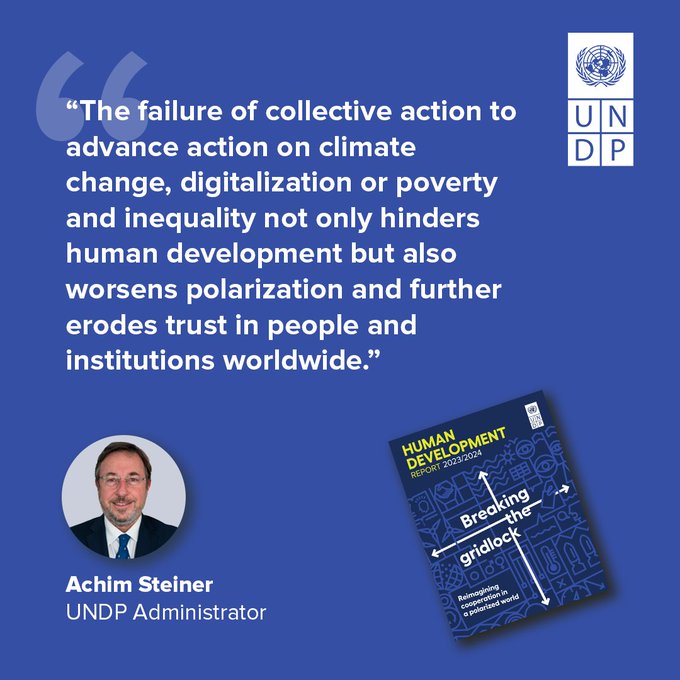
The 2023/24 Human Development Report assesses the dangerous gridlock resulting from uneven development progress, intensifying inequality, and escalating political polarization, that we must urgently tackle. The report emphasizes how global interdependence is being reconfigured and proposes a path forward where multilateralism plays a pivotal role. Why does pursuing the ambitions of the 2030 Agenda for… Continue reading Reimagining cooperation in a polarized world
UN University report #InterconnectedRisks warns about risk tipping points with irreversible impacts on people and planet
Interconnected Disaster Risks 2023 A United Nations University report released today finds that drastic changes are approaching if risks to our fundamental socioecological systems are not addressed. The Interconnected Disaster Risks report 2023 published by the United Nations University – Institute for Environment and Human Security (UNU-EHS) warns of six risk tipping points ahead of… Continue reading UN University report #InterconnectedRisks warns about risk tipping points with irreversible impacts on people and planet
Reaching the poorest and moving to scale: Exploring emerging practice and trade-offs
In recent years there has been a surge in government-led economic inclusion programs. Economic inclusion’s roots are grounded in approaches that are shown to be effective in reaching people living in extreme poverty. Yet one of the biggest challenges as programs scale up is determining the target groups to be included and how to prioritize… Continue reading Reaching the poorest and moving to scale: Exploring emerging practice and trade-offs

EvalCrisis – lessons learnt at EU Evaluation Support Service
Originally posted on Monitoring & Evaluation & Learning:
What did we learn from Evaluation in Crisis? What are the key reflections that the wider evaluation community developed when adapting processes and methods to the new conditions created by the outbreak of the first global pandemic ever of the modern era? The EU Evaluation Support Service…
Our Planet, Our Future
An Urgent Call for Action SHARE Nobel Prize Laureates and Other Experts Issue Urgent Call for Action After ‘Our Planet, Our Future’ Summit In advance of the G7 summit in the UK, a scientific statement signed by an unprecedented 126 Nobel Laureates has been delivered to summit leaders. The statement said, “Without transformational action this… Continue reading Our Planet, Our Future
NDICI is the new EU Instrument for Neighbourhood, Development and International Cooperation
European Commission welcomes political agreement on future €79.5 billion for a new instrument to finance the EU external action and lead the global recovery through international partnerships The European Union will soon have a unified instrument that will make the financing of EU external action more coherent, transparent and flexible, and will allow the EU… Continue reading NDICI is the new EU Instrument for Neighbourhood, Development and International Cooperation
Global Civil Society Report #SpotlightSDGs on the 2030 Agenda and the SDGs
Shifting policies for systemic change Lessons from the global COVID-19 crisis Download (pdf)Download this chapter in pdf format here. Global Civil Society Report on the 2030 Agenda and the SDGs A world in turmoil needs fundamental change Compiled by Jens Martens, Global Policy Forum The COVID-19 pandemic and the national responses to it brought the… Continue reading Global Civil Society Report #SpotlightSDGs on the 2030 Agenda and the SDGs

Germany debates law to make Global Value Chains fair
Global Value Chains (GVCs), the international fragmentation of production, have changed and are changing the international trade. There was much hope that developing countries can realize the benefits of GVCs in the World Development Report 2020. The inequalities in social and environmental conditions, however, have sparked a strong debate in Germany. Despite the global meaning,… Continue reading Germany debates law to make Global Value Chains fair
Scaling-up job opportunities in food systems for youth and women in West Africa
Development Matters By Koffi Zougbédé, Sahel and West Africa Club Secretariat(SWAC) In 2011, Fatoumata Cissoko, a graduate in accounting and a young woman living in Guinea, launched her dried-fruit processing company with USD260. Her company produces about 16 tonnes of dried pineapple a year sold in many shops and supermarkets in the capital, Conakry, and… Continue reading Scaling-up job opportunities in food systems for youth and women in West Africa
COVID-19 and the human development crisis: what have we learnt?
Development Matters By Pedro Conceição, Director of the Human Development Report Office and lead author of the Human Development Report and Mario Pezzini, Director of the OECD Development Centre and special adviser to the OECD Secretary-General on development This blog is part ofa series on tackling COVID-19in developing countries. Visitthe OECDdedicated pageto access the OECD’s… Continue reading COVID-19 and the human development crisis: what have we learnt?
The Future of Financing for Development
Development Matters By Mahmoud Mohieldin, United Nations Special Envoy for the 2030 Agenda, and Benjamin Singer, Economic Affairs Officer, United Nations This blog is part of a series on tackling COVID-19 in developing countries. Visit the OECD dedicated page to access the OECD’s data, analysis and recommendations on the health, economic, financial and societal impacts of COVID-19 worldwide. This blog is… Continue reading The Future of Financing for Development
The G20 and the failure of policy coordination during COVID-19
Development Matters By Paola Subacchi, Professor of International Economics at Queen Mary University of London’s Global Policy Institute, is the author, most recently of The Cost of Free Money(Yale University Press, 2020) This blog is part of a series on tackling COVID-19 in developing countries. Visit the OECD dedicated page to access the OECD’s data, analysis and recommendations on the… Continue reading The G20 and the failure of policy coordination during COVID-19
Why quality assurance infrastructure matters to fight COVID-19 in developing countries?
Development Matters By Karl-Christian Göthner, Consultant, Physikalisch-Technische Bundesanstalt PTB, Germany This blog is part of a series on tackling COVID-19 in developing countries. Visit the OECD dedicated page to access the OECD’s data, analysis and recommendations on the health, economic, financial and societal impacts of COVID-19 worldwide. The COVID-19 pandemic demonstrates that health systems in many countries – developed and… Continue reading Why quality assurance infrastructure matters to fight COVID-19 in developing countries?
Exchange of tax information: a butterfly effect on domestic resource mobilisation
Development Matters By Zayda Manatta, Head of the Secretariat of the Global Forum on Transparency and Exchange of Information for Tax Purposes One small change can make a big difference in the fight against illicit financial flows. Illicit financial flows (IFFs) deprive developing countries and regions of much-needed resources to finance and achieve their development… Continue reading Exchange of tax information: a butterfly effect on domestic resource mobilisation
Engaging citizens for sustainable development: Core business for a better recovery
Development Matters By the Co-Chairs of the OECD Development Communication Network (DevCom): Nanette Braun, Chief, Communications Campaigns Service, UN Department of Global Communications, Amalia Navarro, Director of Communications, Ibero-American General Secretariat (SEGIB) and Mathilde Schneider, Director of Communications, French Development Agency (AFD) This blog is part of a series on tackling COVID-19 in developing countries. Visit the OECD dedicated page to access the… Continue reading Engaging citizens for sustainable development: Core business for a better recovery
COVID-19: super-accelerator or game-changer for international (development) co-operation?
Development Matters By Stephan Klingebiel, Director of UNDP’s Global Policy Centre in Seoul, Republic of Korea and Artemy Izmestiev, Policy Specialist, UNDP’s Global Policy Centre in Seoul, Republic of Korea This blog is part of a series on tackling COVID-19 in developing countries. Visit the OECD dedicated page to access the OECD’s data, analysis and recommendations on the health, economic, financial and… Continue reading COVID-19: super-accelerator or game-changer for international (development) co-operation?
How COVID-19 can change incentives for development co-operation
Development Matters By Nilima Gulrajani, Senior Research Fellow, ODI This blog* is part of a series on tackling COVID-19 in developing countries. Visit the OECD dedicated page to access the OECD’s data, analysis and recommendations on the health, economic, financial and societal impacts of COVID-19 worldwide. There is nothing new in accusing bilateral donors of repurposing foreign aid to serve their domestic… Continue reading How COVID-19 can change incentives for development co-operation
Remittances during COVID-19: Reduce costs to save livelihoods
Development Matters By Paul Horrocks, Manager, Private Finance for Sustainable Development; Friederike Rühmann, Policy Analyst; and Sai Aashirvad Konda, Consultant at the OECD Development Co-operation Directorate This blog is part of a series on tackling COVID-19 in developing countries. Visit the OECD dedicated page to access the OECD’s data, analysis and recommendations on the health, economic, financial and societal impacts of COVID-19… Continue reading Remittances during COVID-19: Reduce costs to save livelihoods
Social protection and sub-regional integration: fundamental instruments for post-COVID-19 social reconstruction
Development Matters By Alfredo Suárez Mieses, Secretary-General, Central American Social Integration Secretariat (SISCA), and Gabriela A. Ramírez Menjívar, Head of the Multidimensional Poverty, Human Capital Development and Social Protection Area- SISCA This blog is part of a series on tackling COVID-19 in developing countries. Visit the OECD dedicated page to access the OECD’s data, analysis and recommendations on the health, economic, financial… Continue reading Social protection and sub-regional integration: fundamental instruments for post-COVID-19 social reconstruction
Build back better with risk-informed development co-operation
Development Matters By Navid Hanif, Director, Financing for Sustainable Development Office, United Nations Department of Economic and Social Affairs This blog* is part of a series on tackling COVID-19 in developing countries. Visit the OECD dedicated page to access the OECD’s data, analysis and recommendations on the health, economic, financial and societal impacts of COVID-19 worldwide. Covid-19 is endangering lives… Continue reading Build back better with risk-informed development co-operation
How microeconomics can help devise evidence-based policy responses to COVID-19
Development Matters By Ahmed Mushfiq Mobarak, Professor of Economics at Yale University, and Faculty director of the Yale Research Initiative on Innovation and Scale (Y-RISE), and Jaya Wen, Postdoctoral Fellow, Northwestern University This blog is part of a series on tackling COVID-19 in developing countries. Visit the OECD dedicated page to access the OECD’s data, analysis and recommendations on the… Continue reading How microeconomics can help devise evidence-based policy responses to COVID-19

One system, two functions
Originally posted on Quality Infrastructure for Development:
In the first post of this blog, we explained the term Quality Infrastructure. We referred to the definition by INetQI, which is agreed upon by the international associations for accreditation, metrology, standardisation and supporting international organisations. INetQI defined Quality Infrastructure as follows: “…?the system comprising the organisations (public…
COVID-19: New UNDP data dashboards reveal huge disparities among countries in ability to cope and recover
Indicators such as the level of poverty, healthcare capacity, access to internet and social protection can portray how severe the effects of the COVID-19 crisis might be in each of 189 countries. Click here for Spanish and French New York, April 29, 2020 – The United Nations Development Programme (UNDP) today released two new data dashboards that highlight the… Continue reading COVID-19: New UNDP data dashboards reveal huge disparities among countries in ability to cope and recover
European Commission supports pilot Vocational Education and Training mobility scheme for African countries
The results of the pilot Vocational Education and Training mobility (VET) mobility scheme for the Enlargement Countries[1] and Africa (EAC/S34/2018) have now been published. The European Commission has made available €8.5 million for two pilot projects with Africa and one with the Western Balkans in the vocational education and training (VET) sector, confirming its commitment… Continue reading European Commission supports pilot Vocational Education and Training mobility scheme for African countries

G20 Compact with Africa Facility supports green business
Germany and the World Bank establish Facility to scale-up private sector investment in green business in Africa Today, at the second high-level G20 Compact with Africa (CwA) conference hosted by German Chancellor Angela Merkel, Germany and the World Bank launched a new Facility to support private sector investment in green businesses and mobilize financing for… Continue reading G20 Compact with Africa Facility supports green business
 blog.weitzenegger.de
You must be logged in to post a comment.